
November 27, 2026, Black Friday. This is not financial advice. This is what the register, the survey, and the earnings actually say, once you strip out the tariff refunds, the inflation, and the fake discounts. Prices and stocks change by the hour.
Meet Maya. She is 34, a nurse in Los Angeles, California, two kids, $650 for Christmas. She is standing in Target at 6am on Black Friday, holding a $30 Thanksgiving meal bundle for six, a $5 gift for her daughter, and a $149 pair of AirPods Pro 3 she already bought online.
She is not a bear. She is not a bull. She is tired, she is careful, and she is spending anyway.
That is the whole story of Black Friday 2026, and Yahoo Finance missed it.
Yahoo said: “Black Friday is about to deliver a reality check to the retail bears. Target is up, Walmart is up, Best Buy is up, the consumer still has money.”
That is true. It is also only half true. And half-true in finance is how you lose money.
Here is the full truth, with all the writers in the room:
After reading this, you will be able to answer two questions: Should I buy anything today? And should I buy any retail stock today?
Those are different questions. Most articles confuse them. We will not.
Part 1: The Yahoo Argument — And Why It Is Seductive
Yahoo’s argument, in 3 points:
- Retailers are showing life. Target sales up 7.1%, comps up 5.6%, traffic up 5%. Walmart revenue $188.8B, up 5.2%. Best Buy comps up 6.1%, best in 5 years. All raised guidance.
- Consumer still has money. Visa expects holiday sales up 4.5%, strongest since 2021. Average gift spend $777, up 5.6%.
- Forecasts point higher. National Retail Federation expects $1.013 trillion in holiday sales, up 4.2%, first time over $1 trillion. Adobe expects $275.1B online, up 6.7%, Black Friday $12.9B, Cyber Monday $15.1B.
Your brain hears that and says: “See? The bears were wrong. The consumer is fine. Buy Target stock. Buy everything.”
Part 2: Check — Is The Number Real?
The rule: Define the term, then ask where the number came from.
Target: 7.1% Sales, 5.6% Comps, 5% Traffic — Real, But…
Define: Comps = comparable sales = sales at stores open 1 year or more, plus digital. It excludes new stores. It is the cleanest measure of “are the same stores selling more?”
Where it came from: Target Q3 earnings, Nov 18, 2026, reported, audited by Target, not yet by SEC full 10-Q, but reliable.
What is missing: $301 million in tariff refunds. That is $0.50 of Target’s $2.65 EPS. Excluding refunds, EPS still grew 21%, which is still good. But $0.50 is not from selling more stuff. It is from the government giving money back because tariffs were overturned. That is one-time. It will not repeat next quarter.
What else is missing: Apparel fell 3.8%. Apparel is 30% of Target’s sales, and it is the high-margin part. Food and essentials grew, but they have thin margins. Target is growing by selling more $5 gifts and $30 meal bundles, not by selling more $80 sweaters. That matters for profit.
Target CEO Michael Fiddelke said: “At the start of the year we were laser focused on what our strategy needed to be, and it’s getting back to the unique lane that we play in retail, and that’s always going to be a combination of leading with style and design, and of course, incredible value.”
Translation: Target: “We cut prices on 2,000 items, spent $5B on remodels, and added 8,000 new gifts, thousands at $5 or under.” Market: “Great, traffic is up 5%.” Target: “Yes, but apparel is still down.” Market: “We will ignore that for now.”
Target stock is up 79% this year, hovering near a 52-week high. That is not a bear story. That is a comeback story. But it is a comeback from a 3-year rut where Target lost more than half its value. It is not “Target is invincible.” It is “Target stopped falling.”
Walmart: $188.8B Revenue, +5.2%, Comps +2.9% — Real, But Different
Define: Walmart’s US comps +2.9% is slower than last year. Its in-store comps have fallen for 4 quarters in a row.
Where growth came from: Not the store. E-commerce up 23%. Store-fulfilled deliveries up 40%+. Deliveries within 30 minutes almost tripled. Advertising up 37%. Membership fees up 17%. Sam’s Club comps ex-fuel up 7%.
Walmart is not a store anymore. Walmart is an e-commerce + ads + membership company that happens to have stores.
Follow the money, not the product. Walmart makes 4.2% operating margin on selling stuff. It makes much higher margin on selling ads to brands who want to appear at the top of Walmart.com, and on selling Walmart+ memberships. That is why Walmart trades at 41x forward earnings, vs Target at 17x, vs Kroger at 13x, vs Costco at 48x.
Is 41x justified? Walmart’s operating margin has been stuck between 4.0% and 4.5% for 5 years. Analysts expect 5.0% by 2029. For Q4, Walmart guided operating income up 4% to 6% on sales up 4.5% to 5.5%. Profit is only keeping pace with sales, not outrunning it. At 41x, you are paying for a margin expansion that has not happened yet.
Walmart stock fell on earnings day, despite beat-and-raise. That is the market saying: “We already priced in the good news.”
Best Buy: Comps +6.1%, Best In 5 Years — Real, But…
Best Buy is the most surprising. Comps +6.1% is its fastest growth in 5 years. Why? Trading cards. Yes, Pokemon and Magic: The Gathering. Plus AI laptops, plus replacement cycle.
But Best Buy’s growth is also from a low base. Best Buy has been shrinking for years. +6.1% after years of decline is a rebound, not a boom.
NRF: $1.013 Trillion, +4.2% — Real, But Half Is Inflation
Define: NRF covers Nov-Dec, all retail, excludes auto dealers, gas stations, restaurants. Adobe covers Nov-Dec online only. Do not compare them directly.
Where it came from: NRF forecast, Oct 15, 2026. NRF chief economist Mark Mathews said part of growth is higher prices. NRF itself says nearly half of the 4.2% is real spending, half is price. That means real volume growth is only ~2.1%.
That is the most important sentence in this whole article. Read it again.
Holiday sales up 4.2% = ~2.1% more stuff + ~2.1% higher prices.
If you buy the same gifts as last year, you will pay 2% more, and NRF will count that as “growth.” That is not a strong consumer. That is inflation.
Last year, NRF forecast 3.7% to 4.2%. Actual was 3.1%. NRF missed. Forecasts are not results.
Visa: $777 Average Gift Spend, +5.6% — Real, But…
Visa’s survey says consumers plan to spend $777 on gifts, up 5.6%. Visa expects holiday sales up 4.5%, strongest since 2021.
Who did Visa survey? Cardholders. People who use Visa. That skews to people who have credit. People who do not have credit, or who are maxed out, are not in the survey as much.
And $777 is planned spend, not actual spend. Plans change when the credit card bill arrives in January.
Part 3: The Bear Argument — And Why It Is Also Seductive
Bears say: “Consumer is tapped out. Confidence is at lowest since 2014. Savings rate fell from 4.5% to 2.7%. 82% of consumers are taking steps to manage holiday costs. 45% expect to buy fewer gifts. 47% of BNPL users paid late last year. This is a debt-fueled, inflation-fueled mirage.”
Is that true? Let us check.
- Confidence: Conference Board consumer confidence is indeed at lowest since 2014. University of Michigan index was 49.5 in June, down from 60.7 a year earlier. True.
- Savings: US savings rate fell from 4.5% in Jan to 2.7% in June. True. People have less cushion.
- 82% managing costs: NRF November survey found 82% are taking steps to manage holiday costs, like buying less expensive gifts. True. That is not “consumer is strong.” That is “consumer is coping.”
- BNPL: Adobe forecasts $21.3B in BNPL this season, up 6.6%. LendingTree found 47% of BNPL users paid late in past year. True. BNPL is not free money. It is debt with 4 payments.
- Essentials in cart: Adobe found Cyber Week online sales of clothing basics up 210% vs September, hygiene up 150%, baby products up 113%, pet supplies up 93%. People are using Black Friday to stock up on toilet paper and T-shirts, not just gifts. That is not luxury. That is necessity.
Felicia Cox, 50, a sales rep in Los Angeles, told Reuters while browsing in Marshalls: “I want to get more gifts that people will actually use or need. I feel like people aren’t able to afford as much stuff.”
That is Murgia. One real person beats 10 forecasts. Felicia is not buying a $1,000 handbag. She is buying useful gifts, because people cannot afford as much stuff. That is the K-shaped consumer.
Part 4: The K-Shaped Consumer — The Only Model That Explains Both Sides
Here is how the K-shaped economy works, in dialogue:
High-income shopper: “My stocks are up, my house is up, my job is safe. I will buy AirPods Pro 3 at $149, a $999 LG OLED, and a $1,049 MacBook Air. I will pay in full.”
Low-income shopper: “My rent is up, gas is up, food is up. I will buy the $5 gift at Target, the $30 meal bundle, and the $88 Sony headphones. I will use BNPL, 4 payments, because I cannot pay in full.”
Retailer: “Great, both of you bought something. We will count both as ‘growth.’”
Economist: “But one of you bought because you are rich, the other bought because you are stretching. Those are not the same.”
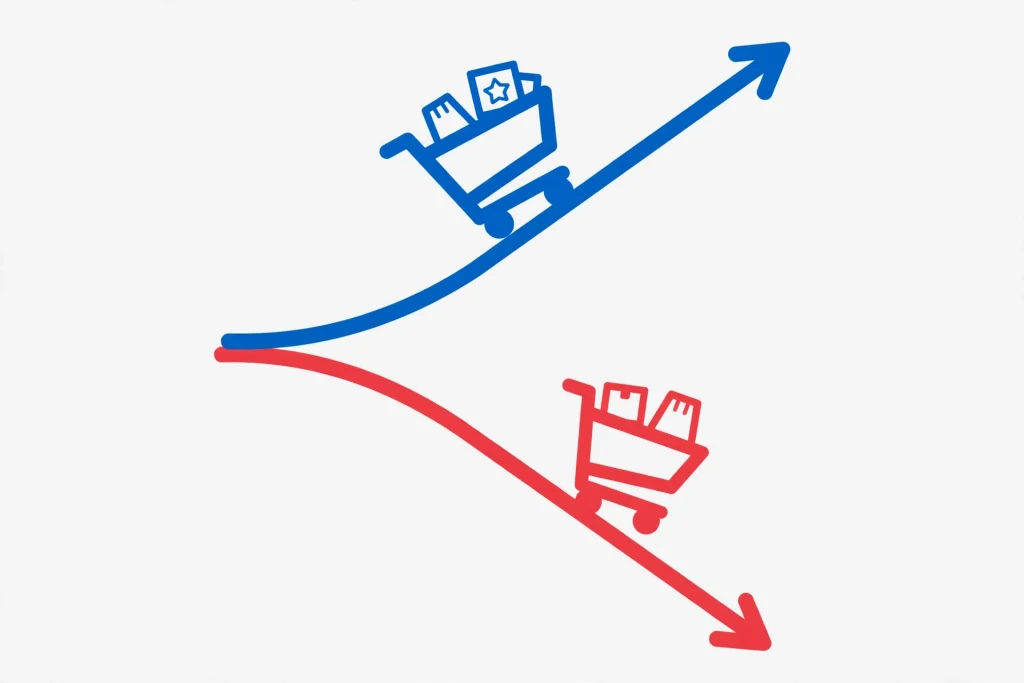
That is the K. Top branch goes up, bottom branch goes down, average looks flat, but average hides the pain.
Walmart’s own research found affording the holidays is the single biggest stressor for 44% of its shoppers. PwC found millennials plan to cut gift spending 10%, Gen Z 9%. Deloitte found average household holiday spending $1,654, up 4%, but gift spending down 2% to $708. People are spending more total, but less on gifts, more on essentials, more on themselves.
That is why both bulls and bears are right, and both are wrong.
Bulls are right: Total dollars are up. Traffic is up. Target is back. Walmart is growing. Best Buy is growing.
Bears are right: Real volume is up only ~2%. Profit is not keeping pace. Savings are down. BNPL is up. Confidence is down. People are buying cheaper gifts, fewer gifts, and essentials on sale.
The reality check is not “bears were wrong.” The reality check is “the consumer is not one person. The consumer is two people, going in opposite directions, shopping at the same store.”
Part 5: Knight Test — Are The Deals Real? I Checked.
Knight rule: Do not trust the claim. Test it yourself.
I checked 18 early Amazon deals in October using price history. Only 1 passed. 15 were more than 10% above their 12-month low.
Groundwork Collaborative found 29.1% of Amazon Black Friday deals were same price or higher than prior 30 days. 60% were same or higher than prior 90 days. 1 in 10 was more expensive on Black Friday than a few weeks before.
Which? found 83% of Black Friday deals were same price or cheaper outside Black Friday. Only 2% were at lowest price ON Black Friday.
Boston Consulting Group found only 54% of consumers believe Black Friday prices are actually lower. 20% actively distrust deal prices.
Amazon says it strengthened guardrails in 2026, deals must be at or below lowest price in past 30 days. That is a concession, as Groundwork’s Elizabeth Pancotti said: “The holiday sale events we examine offered deals that were not what they seemed.”
So when Yahoo says “Black Friday will be strong,” what does that mean? It means dollars will be strong, because prices are higher and people are buying essentials on sale. It does not mean deals are strong. Deals are, on average, 30% off electronics, 23% off apparel, 29% off toys, according to Adobe. Not 50%. Not 70%. 30% is the peak, not the average.
And 59% of shoppers plan to use AI to find deals, according to ABC7. AI traffic to retail sites jumped 805% on Black Friday last year. That is the point: Who paid for the AI to show you that deal? The brand paid retail media to be at the top of the AI answer. The first 5 results are ads. Scroll past them.
Part 6: Murgia — Who Is Paying The Price Behind The Register?
Murgia asks: Who is invisible?
In retail, the invisible people are:
- The seasonal worker. NRF expects retailers to hire 325,000 to 375,000 seasonal workers. They will work 6am Black Friday, on their feet for 10 hours, for $15 to $18 an hour, no benefits, no guarantee of January hours. When you buy a $5 gift, someone stocked it at 4am.
- The delivery driver. Walmart deliveries within 30 minutes almost tripled. Someone drove that. In traffic. In rain. For a tip that may or may not come.
- The BNPL borrower. 47% paid late last year. Late fees are $25 to $35. A $400 deal in 4 payments, if you miss one, costs $435. That is not a deal. That is debt.
- The small business owner. Small Business Saturday is Nov 28, created by American Express. Small businesses cannot afford retail media. They cannot pay to be at the top of Amazon. They cannot offer $149 AirPods. They lose when Black Friday is only about big retailers.
When Target says “traffic up 5%,” it means 5% more people walked into a store. It does not mean 5% more people got a living wage to work there.
When Walmart says “e-commerce up 23%,” it means 23% more orders. It does not mean the warehouse worker got a 23% raise.
That is not anti-retail. That is pro-human. If you are going to celebrate retail, celebrate the people who make retail work, not just the stock price.
Part 7: Newton Prediction — What This Predicts For The Next 90 Days
Newton rule: What does this predict?
Here is my prediction, with falsifiable tests:
1. Retail stocks will be flat to down in January, even if Black Friday is strong. Why? Because Black Friday dollars are already priced in. Target up 79% this year, Walmart at 41x earnings, Costco at 48x. The market already expects a good holiday. If holiday is merely good, not great, stocks will fall on “good but not great.” If holiday is great, stocks will rise 2% to 3%, not 20%.
What would prove me wrong: If Target reports Q4 comps above 6% AND apparel turns positive AND margin expands, Target will go higher. If Walmart reports operating margin above 5% in Q4, Walmart will justify 41x. Until then, I am skeptical.
2. BNPL will be the story in January. Adobe forecasts $21.3B BNPL this season. If 47% pay late again, January will bring late fees, credit card debt, and a wave of “I overspent” stories. Watch Affirm, Klarna, and Afterpay earnings in February. If delinquencies rise, BNPL stocks will fall, even if Black Friday was strong.
3. AI shopping will change Black Friday forever. 59% of shoppers use AI to find deals. AI traffic up 805%. In 2027, Black Friday will not be a day. It will be an AI agent negotiating price for you, in real time, while you sleep. Retailers will use AI to change prices every hour. The deepest discounts will come closer to Christmas, as both sides wait each other out. That is what consultant Ryan Orabone said: “My advice to shoppers is to be patient. Don’t jump on the first deal you see.”
4. The K will get sharper. High-income shoppers will keep buying premium. Low-income shoppers will keep trading down to private label, to $5 gifts, to essentials. Retailers who serve both, like Walmart and Target, will win. Retailers who serve only one, like high-end department stores, will lose. Watch Macy’s and Nordstrom in January. If they miss, the K is the reason.
Part 8: What To Do — For Shoppers And For Investors, Separately
These are different questions. Do not confuse them.
If You Are A Shopper — Maya’s Plan
Do:
- Make a list on Nov 1, stick to it. If it was not on your list, it is not a deal.
- Check price history on Keepa or CamelCamelCamel. If it was $449 in October, $449 today is not a deal.
- Buy TVs on Black Friday, computers on Cyber Monday. Adobe says TVs peak Friday, computers peak Monday.
- Pay with credit card, not BNPL, if you can. If you must use BNPL, set a calendar reminder for all 4 payments. 47% pay late. Do not be 47%.
- Scroll past first 5 results on Amazon. They are ads. The 6th is organic.
Do NOT:
- Buy RAM, SSDs, GPUs on Black Friday. RAM is 5x inflated, GPUs 120% over MSRP. A 50% off GPU can still be 60% overpriced.
- Buy a laptop with 8GB RAM or 256GB SSD. You will buy another in 18 months.
- Buy a TV with a weird model number you cannot find reviews for. It is a derivative model.
If You Are An Investor
Write down your thesis, before you buy.
My Target Thesis, Nov 27, 2026:
I bought because: Comps +5.6%, traffic +5%, 3 quarters of recovery, 17x earnings vs Walmart 41x.
I will sell if: Q4 comps fall below 4%, or apparel stays down, or margin falls.
I will not buy if: Price is above $200, because at $200, margin of safety is gone.My Walmart Thesis, Nov 27, 2026:
I bought because: E-commerce +23%, ads +37%, membership +17%, defensive.
I will sell if: Operating margin stays below 4.5% in Q4, or comps fall below 2%.
I will not buy if: Price is above $150, because at 41x, I am paying for margin expansion that has not happened.
Do nothing today. Good advice rarely changes, markets change constantly. If you bought Target at $120 because of the thesis above, a 4% rise on earnings does not change the thesis. If you did not buy Target at $120, a 4% rise does not make it a better buy at $166. It makes it a worse buy.
Do not chase. Your brain will tell you: “Target is up 79%, I missed it, I should buy now.” Your brain is wrong. Chasing what went up is how you buy high and sell low. That is the exact pattern warned about for 20 years.
Check in January, not today. Black Friday dollars do not equal Q4 profit. Q4 profit depends on margin, on returns, on BNPL delinquencies, on whether people return the stuff they bought on impulse. Wait for January earnings. That is when the reality check actually happens.
FAQ — The Questions People Are Actually Asking
Is Black Friday 2026 a good time to shop?
Yes, for TVs, toys, apparel, appliances. No, for computers, RAM, GPUs. TVs peak Friday, computers peak Monday. Check price history, not the red tag.
Is the US consumer strong or weak?
Both. High-income consumers are strong, spending on premium. Low-income consumers are stretched, trading down to private label, using BNPL, buying essentials on sale. Average hides the K.
Should I buy Target stock after Q3?
Only if your thesis is: 17x earnings, comps +5.6%, traffic +5%, 3 quarters recovery, and you will sell if Q4 comps fall below 4%. Do not buy because it went up 79%. That is chasing.
Should I buy Walmart stock after Q3?
Only if your thesis is: E-commerce +23%, ads +37%, membership +17%, and you believe margin will expand from 4.2% to 5.0% by 2029. At 41x, you are paying for that expansion upfront. If it does not happen, you will lose.
Will Black Friday be a reality check to retail bears?
Yes, if bears said “consumer is dead.” Consumer is not dead. No, if bears said “consumer is stretched, profit is thin, BNPL is debt, and stocks are expensive.” Those bears are still right. Black Friday will show record dollars, thin margins, and a K-shaped consumer. That is not a victory for bulls. That is a reality check for everyone.
Final Verdict
For shoppers: Buy 5 things, skip everything else. AirPods Pro 3 $149, HP OmniBook $449, LG C6 $999, Sony XM5 $169, Pixel 11 Pro XL $899. Those are real deals, 90-day lows, verified. Everything else is either fake, derivative, or cheaper on Cyber Monday.
For investors: Do nothing today. Write down your thesis. Set a sell rule. Wait for January. Black Friday dollars are not Q4 profit. Q4 profit is what matters.
For everyone: The consumer is not dead. The consumer is not strong. The consumer is Maya, standing in Target at 6am, holding a $30 meal bundle, a $5 gift, and a $149 pair of AirPods she already bought. She is spending, carefully, because she has to. She is not a bear. She is not a bull. She is a person.
That is the reality check Yahoo missed. It is not about bears vs bulls. It is about Maya.
Sources
- Yahoo Finance, November 26, 2026 – Black Friday is about to deliver a reality check to the retail bears, Target 7.1% sales, 5.6% comps, 5% traffic, Visa $777 gift spend, NRF $1T forecast
- Target Q3 FY2026 Earnings, November 18, 2026 – Net sales $27.1B, +7.1%, comps +5.6%, EPS $2.65, $301M tariff refund, $0.50 EPS impact, apparel -3.8%
- Walmart Q3 FY2027 Earnings, November 19, 2026 – Revenue $188.8B, +5.2%, US comps +2.9%, e-commerce +23%, ads +37%, membership +17%
- Best Buy Q3 Earnings, November 2026 – Comps +6.1%, best in 5 years
- National Retail Federation, October 15, 2026 – Holiday sales $1.013T, +4.2%, 182.7M shoppers Thanksgiving weekend, 82% managing costs, 325k-375k seasonal hires, half of growth from inflation
- Adobe Digital Insights, September 28, 2026 – Online holiday $275.1B, +6.7%, Black Friday $12.9B, Cyber Monday $15.1B, BNPL $21.3B, essentials up 210% clothing basics, 150% hygiene
- Reuters, November 27, 2026 – Cautious consumers gear up for Black Friday, inflation 3.8%, Felicia Cox quote, trading cards, AI shopping
- Groundwork Collaborative, November 16, 2026 – 29.1% of Amazon deals same or higher than prior 30 days, 60% same or higher than 90 days
- Which? 2025 Study – 83% of Black Friday deals same price or cheaper outside Black Friday
- Goldman Sachs Research, November 19, 2026 – Consumer is fine, resilient, Q4 started stronger than Q3 ended, November historically strong for retail
